

Elections in 2026 offer a generational opportunity for Wisconsin Democrats
Sorting through the big picture of the year ahead, and analyzing why 2026 could be the year where Democrats win a trifecta for the first time in a long time.
The Recombobulation Area is a 19-time Milwaukee Press Club award-winning opinion column and online publication founded by longtime Milwaukee journalist Dan Shafer. The Recombobulation Area is now part of Civic Media.
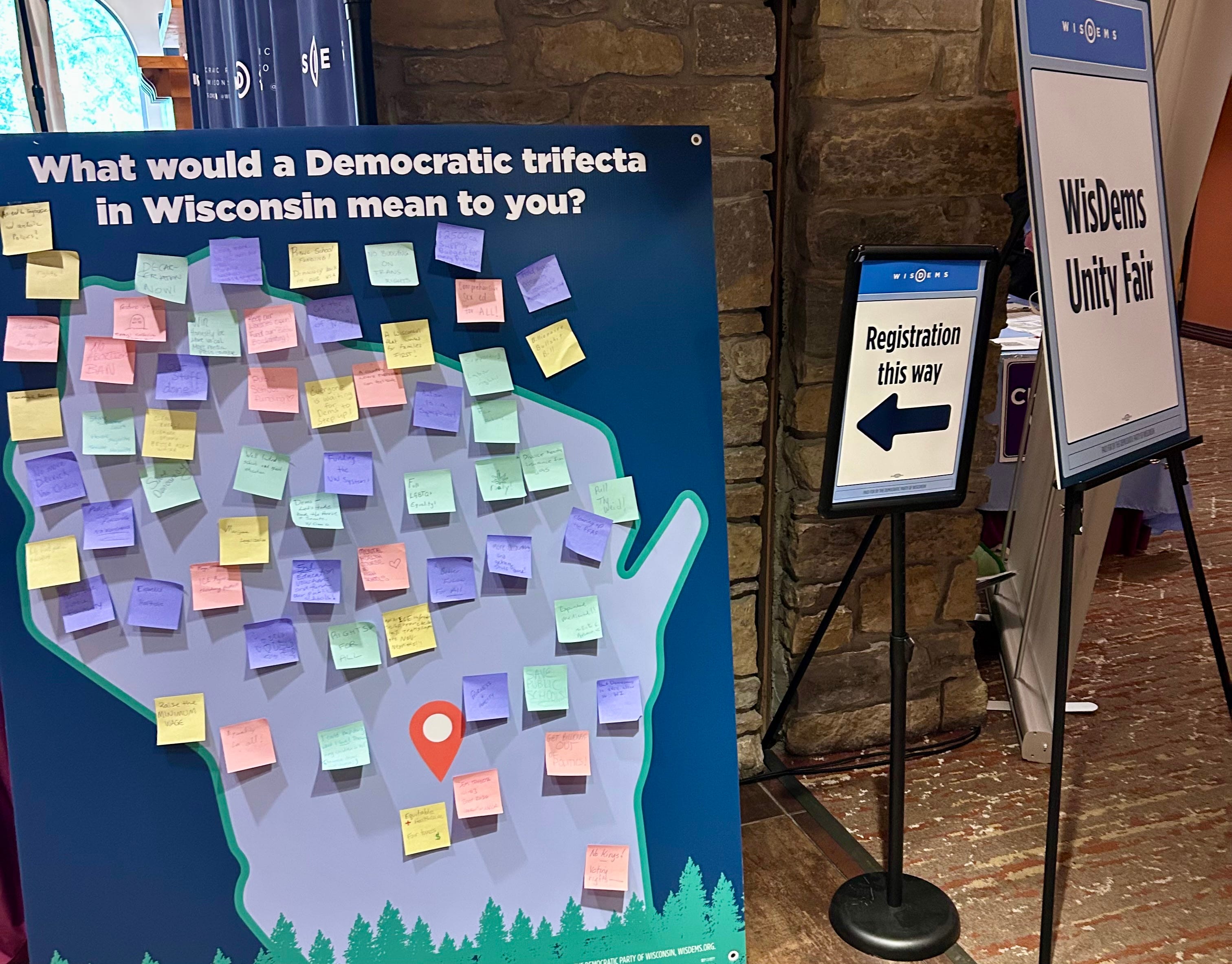
As the calendar turns from 2025 to 2026, the horrors continue to persist, but we have once again arrived in an election year. Perhaps that brings with it some fresh hope for change.
In Wisconsin, pretty much every year is an election year. But this one is different. Because 2026 brings with it the greatest electoral opportunity for state Democrats in a generation. The fall midterm elections will offer the first real chance for a Democratic trifecta in more than 15 years. And in the Spring Election in April, liberals could expand their state Supreme Court majority, solidifying their control of the state’s highest court through the rest of the 2020s, with how the next few elections look to line up.
In November, there will be the first open contest for governor since 2010, along with statewide races for Attorney General, State Treasurer and Secretary of State. And in the legislature, this year will have the first election to be fully held under new, fairer maps, as only half of the State Senate was on the ballot in 2024. If Democrats hold the governorship and flip the Senate and Assembly, they would walk into 2027 with more political power than they’ve seen in decades.
There are two sides to this coin, of course. Republicans could seize the very same opportunity. They could hold their legislative majorities in both chambers and win the race for governor.
But that wouldn’t produce the kind of sea change that Democratic victories would, particularly in the legislature, where Republicans have controlled both chambers — with often outsized, gerrymandered majorities — since 2011. Since 1994, Democrats have only controlled the State Assembly for two of those 30-plus years. While Republican control of the legislature would essentially amount to more of the same, a Democratic trifecta in Wisconsin would be a bonafide political earthquake.
And in 2027, a Democratic trifecta is indeed a real possibility. It might not be the most likely outcome, but it is very much on the table. They’d simply need to win districts that were won by Kamala Harris and Tammy Baldwin in 2024, in what was likely a more Republican-leaning election cycle than what 2026 projects to be.
But I would not go as far as to say that Democrats are the favorites to flip both the Senate and Assembly. The Assembly, in particular, has certain challenges for Democrats, given incumbency and political geography, and even as they considerably shrunk the margin of Republicans’ majority in 2024 under new maps, Democrats did underperform expectations overall.
The State Senate is another story. Senate Democrats proved to be one of the few bright spots for the left in the 2024 election, going five-for-five in competitive races, shrinking Republicans’ majority in the chamber to just a three-seat margin. From a governing standpoint, this brought Minority Leader Dianne Hesselbein to the negotiating table for the state budget, as Democratic votes were needed for final passage for the first time in a long time, leading to a number of significant wins for the state.
Now, Democrats need to flip just two seats in order to control the upper chamber. And there were three districts won by Harris and Baldwin in 2024 that have yet to be on the ballot under new maps — District 17 in southwestern Wisconsin, District 5 in Milwaukee’s western suburbs, and District 21 in Racine County and southern Milwaukee County. Each of those districts have a strong Democratic candidate who has already been running for some time (State Rep. Jenna Jacobson in the 17th1, State Rep. Robyn Vining in the 5th, and Racine transit director Trevor Jung in the 21st). Under Hesselbein’s leadership, Senate Democrats have been a very organized group. I’d even go as far as to say that Democrats should be considered the favorites to flip the Senate. They’d need to win just two of those three seats, and hold another key seat in District 31 in the Eau Claire area, a district currently represented by Democrat Jeff Smith, who is running for re-election. It’s early, of course, and we don’t know which incumbent Republicans might be running for re-election, but there is a strong chance Democrats win control of the State Senate in this fall’s election.

But the headline race will, of course, be the one for governor. In Wisconsin, every statewide race should be viewed as a 50-50 toss-up. An open contest means a whole lot of uncertainty, and though Mandela Barnes’ entry makes his the biggest name in the primary, I don’t believe he walks in as the clear frontrunner in the same way he was in 2022’s Democratic primary for U.S. Senate. But on the whole, this is a strong bench of qualified candidates ready to pick up the torch from Gov. Tony Evers. Hopefully, these next few months of primary campaigning will offer a compelling conversation about where Wisconsin could be headed in the years to come. The first of these will be happening on Jan. 21 at The Cooperage in Milwaukee (with yours truly as the moderator!).
For Republicans, this is not a deep bench of candidates — it’s likely nominee Tom Tiffany, the congressman from the 7th District and a former state legislator, and a quixotic going-nowhere campaign from Washington County Executive Josh Schoemann. If Tiffany falters in fundraising, that could open the door for a self-funder like Tim Michels to run it back (Eric Hovde passed on this one, he announced), but that seems somewhat unlikely. None of these candidates, though, stand out as having distinct crossover appeal or the type of Trumpian cult of personality that drives lower-propensity voters to the polls. Besides, the best potential statewide candidate for Republicans is Bryan Steil, and he is running not for governor, but for re-election in the 1st Congressional District. This is not a field that’s going to strike fear into the hearts of Democrats who have been far more successful in statewide races in recent years.
Then there’s the national environment, and the history of midterm elections. The party that does not control the White House tends to do better in the midterms; this happens over and over. Even before acknowledging the relative unpopularity of President Trump — particularly on the economy, which was a strength of his during his first term, less so now — this could mean a 50-50 state like Wisconsin should have a slight edge for the Democrats in such an election.
However, one factor to consider is that there is no election for U.S. Senate in Wisconsin this year. In 2018 and 2022, there was a corresponding Senate election also on the ballot with a gubernatorial race. To a certain degree, not having both on the same ballot this could insulate this race from being heavily influenced by national media narratives, with more of a focus on state-level politics. This could create certain openings for Republican candidates to not be as tied to an unpopular president — or for Democrats not to be tied to an unpopular national party.
But there’s a whole year of unpredictable and discombobulating politics ahead of us, and the issues we’re talking about now could be in the rear view mirror by the time people are casting primary ballots in August. But if I were to be making predictions about these 2026 races right now, I’d say Democrats flip the Senate and keep the governorship, but Republicans hold a majority in the Assembly.
Before we get to the fall, though, there’s the Spring Election on April 7. There, Chris Taylor, the former Democratic legislator and current Court of Appeals judge, has to be considered the favorite. With Justice Rebecca Grassl Bradley, the right-wing incumbent, opting against running for another 10-year term, Waukesha-based Court of Appeals Judge Maria Lazar seems to be the only conservative-aligned candidate running. Taylor has had a big head start in campaigning and fundraising — she reported setting a new fundraising record, being ahead of now-Justice Susan Crawford midway through 2025 — and liberal candidates have won every state Supreme Court race in the 2020s by double-digit margins. There’s no reason to suggest the environment for this race has drastically changed in conservative’s favor. By August, when a new justice is seated, liberals could have a 5-2 majority on the state’s highest court, with one of those two conservative justices being Brian Hagedorn, who has sided with liberals in many key cases. A win for Taylor could cement this liberal majority for years to come.
The opportunity for the left in Wisconsin in 2026 elections cannot be overstated. It’s a generational moment for the state. That starts in April with the state Supreme Court race and carries through to what could be a transformational election on Nov. 3.
There has been no moment like this for Democrats in Wisconsin in decades. If this opportunity is realized, the state could be forever changed.

Dan Shafer is a journalist from Milwaukee who writes and publishes The Recombobulation Area. In 2024, he became the Political Editor of Civic Media. He’s written for The New York Times, The Daily Beast, Heartland Signal, Belt Magazine, WisPolitics, and Milwaukee Record. He previously worked at Seattle Magazine, Seattle Business Magazine, the Milwaukee Business Journal, Milwaukee Magazine, and BizTimes Milwaukee. He’s won 23 Milwaukee Press Club Excellence in Journalism Awards. He’s on Twitter at @DanRShafer.
Subscribe to The Recombobulation newsletter here and follow us on Facebook and Instagram at @ therecombobulationarea.
Already subscribe? Get a gift subscription for a friend.
Part of a group who might want to subscribe together? Get a group subscription for 30% off!
Follow Dan Shafer on Twitter at @DanRShafer and at BlueSky at @danshafer.bsky.social.
Corrine Hendrickson, who has been a contributor here at The Recombobulation Area, is also running as a Democrat in the 17th.
surprised you've come down pessimistic on dem chances in the legislature. its currently maps just tilted a few points in republicans favor, and there will be a ton of energy against trump this fall.
LFG, Dems!